
Best Concrete Floor Coating for Warehouses
Table of Contents
Types of Industrial Floor Coatings for Warehouses
Epoxy Resin Coatings
Polyaspartic Coatings
Polyurethane and Methyl Methacrylate Systems
Polyaspartic vs Epoxy for Warehouses: Durability and Curing Time
Concrete Substrate Preparation and Adhesion Requirements
Mechanical Substrate Preparation
Moisture Vapor Transmission Testing: The Hidden Failure Point
Substrate Porosity and Primer Selection
Chemical Spill Resistance and Impact Protection
Industrial Epoxy Flooring Cost Per Square Foot and ROI
Breaking Down the Total Cost of Ownership
Concrete Replacement Cost: The Hidden Risk
ROI Comparison: Epoxy vs. Polyaspartic
Making the ROI Decision
Warehouse Floor Coating Maintenance Tips and Longevity
Application Process: Surface Preparation to Final Topcoat
Frequently Asked Questions
Last Updated: September 20, 2026
Types of Industrial Floor Coatings for Warehouses
Choosing the right concrete floor coating for warehouses depends on your facility's traffic patterns, chemical exposure, and timeline. The best concrete floor coating for warehouses isn't universal, it depends on your specific operational demands.
Epoxy remains the industry standard, bonding aggressively to concrete and handling heavy forklift traffic and moderate chemical spills. Its compressive strength typically exceeds 10,000 PSI. However, epoxy's 7-to-14-day curing time can disrupt warehouse schedules.
Polyaspartic coatings allow return to service within 24 to 48 hours, critical for facilities that can't afford downtime. They deliver superior UV stability, resisting yellowing. The tradeoff: higher material costs and stricter application windows.
Polyurethane and methyl methacrylate systems occupy a middle ground. Both offer excellent chemical spill resistance and impact protection, though they're less common than epoxy or polyaspartic options. Methyl methacrylate (MMA) cures rapidly and tolerates moisture better during application, making it suitable for facilities with humidity challenges.
Epoxy Resin Coatings
Epoxy resin coatings dominate warehouse flooring because they excel at adhesion and durability. They create a non-porous surface that resists concrete dusting, a common problem in high-traffic facilities.
Quality epoxy uses 100% solids technology with zero VOC emissions, improving indoor air quality and regulatory compliance. The high-gloss finish improves visibility for forklift operators.
Epoxy's weakness is time: 7 to 14 days of cure before normal operations resume. Epoxy can also yellow under UV exposure, though modern formulations have improved this.
Polyaspartic Coatings
Polyaspartic systems cure in hours, allowing forklifts to return within 24 hours. This rapid return to service makes polyaspartic ideal for distribution centers where downtime costs money.
Polyaspartic's durability matches or exceeds epoxy. It resists thermal shock and UV degradation better than epoxy, and its flexibility resists cracking when concrete shifts, common in older buildings.
The primary objection to polyaspartic is higher material cost and the need for experienced applicators. For warehouses where speed matters, polyaspartic delivers measurable value.
Polyurethane and Methyl Methacrylate Systems
Polyurethane coatings offer excellent chemical spill resistance and impact protection. They perform well in temperature-variable environments, maintaining adhesion across seasonal swings.
Methyl methacrylate (MMA) systems cure quickly and tolerate moisture better than epoxy or polyurethane, making them ideal for humid climates. Textured finishes provide superior slip resistance.
Polyaspartic vs Epoxy for Warehouses: Durability and Curing Time
The polyaspartic vs epoxy decision hinges on speed requirements and budget constraints.
Epoxy wins on material cost.
Polyaspartic wins on speed and UV performance. The 24-hour return to service eliminates epoxy's operational disruption. For tight-schedule warehouses, this speed advantage justifies higher material cost.
Concrete Substrate Preparation and Adhesion Requirements
Surface preparation determines coating success. The most common failure mode, especially in humid climates, is moisture vapor transmission (MVT) from beneath the concrete pushing the coating away from the substrate.
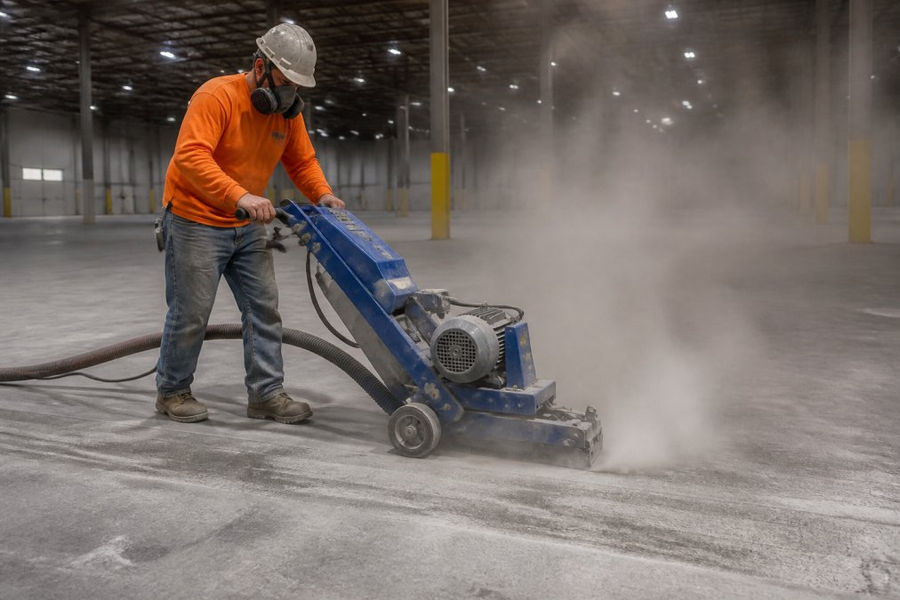
Mechanical Substrate Preparation
Concrete must be cleaned to remove dust, oil residue, old sealers, and deteriorated concrete. Shot blasting or diamond grinding exposes fresh substrate for primer adhesion. Warehouse floors should test at minimum 3,000 PSI compressive strength.
Moisture Vapor Transmission Testing: The Hidden Failure Point
Moisture vapor transmission (MVT) is the primary cause of coating failure in warehouses. When moisture vapor pressure builds beneath a sealed coating, it creates a hydraulic force that separates the coating from the substrate, delamination.
MVT is measured in perms (pounds of water vapor per 1,000 square feet per 24 hours) (E96/E96M Standard Test Methods for Water Vapor Transmission of Materials). The ASTM F1869 calcium chloride test and ASTM F2170 relative humidity test are the industry standards for assessing concrete moisture conditions before coating application.
Critical thresholds:
Below 3 perms: Safe for epoxy and polyaspartic coatings
3 to 5 perms: Requires moisture-blocking primer; standard topcoats may fail
Above 5 perms: Concrete is too wet for coating; requires drying or moisture mitigation system
Warehouses with concrete slabs on grade frequently test above 5 perms. Testing should occur at multiple locations, as moisture distribution is often uneven.
If MVT testing reveals elevated moisture, three mitigation strategies exist:
Moisture-blocking primer: A specialized epoxy or polyurethane primer is applied first to seal the concrete and block vapor transmission. This adds cost and extends the application timeline by 24 to 48 hours but allows coating installation to proceed without waiting for concrete to dry.
Concrete drying: The facility can be dehumidified or heated to reduce concrete moisture content. This is time-intensive (often 2 to 4 weeks) but eliminates the risk of future MVT-related failure.
Vapor-permeable coating system: Methyl methacrylate (MMA) systems tolerate higher moisture levels during application because they cure through a different chemical mechanism than epoxy. MMA can be applied to concrete with MVT readings up to 7 to 8 perms, making it the preferred choice for wet environments.
Substrate Porosity and Primer Selection
Concrete porosity determines primer requirements. High-porosity concrete requires additional primer coats; low-porosity concrete accepts standard application.
Chemical Spill Resistance and Impact Protection
Warehouses storing chemicals need coatings engineered for spill containment. Epoxy and polyaspartic resist common warehouse chemicals and prevent penetration that causes staining and structural damage.
The Painting & Coating Channel
Quality epoxy and polyaspartic systems resist impact damage through flexible topcoat layers. High-gloss finishes make damage and spills immediately visible, prompting cleanup.
Industrial Epoxy Flooring Cost Per Square Foot and ROI
Pricing varies by substrate condition, coating system, and labor rates. A complete ROI analysis must account for installation, downtime, maintenance, and potential concrete replacement costs.
Breaking Down the Total Cost of Ownership
The total cost of a warehouse floor coating includes three components:
1. Installation Cost (Material + Labor)
Surface preparation often equals or exceeds coating cost. Poor substrate condition requires more extensive preparation than clean, well-maintained concrete.
Typical installation cost ranges:
Epoxy: $2.50 to $5.00 per square foot (material + labor)
Polyaspartic: $4.00 to $7.00 per square foot (material + labor)
Methyl methacrylate: $3.50 to $6.50 per square foot (material + labor)
2. Downtime Cost
Downtime is the often-overlooked expense that tips ROI calculations in favor of faster-curing systems.
Downtime cost calculation:
Daily operational cost = (Annual revenue ÷ 365 days) × (Percentage of revenue dependent on warehouse operations)
Total downtime cost = Daily operational cost × Number of days the facility is closed
Example: A 50,000-square-foot distribution center with $50 million in annual revenue:
Daily operational cost = ($50,000,000 ÷ 365) ≈ $136,986 per day
Epoxy installation (7-day cure) = $136,986 × 7 = $958,902 in lost revenue
Polyaspartic installation (1-day cure) = $136,986 × 1 = $136,986 in lost revenue
Downtime savings with polyaspartic: $821,916
For this facility, the higher material cost of polyaspartic ($50,000 to $100,000 more) is offset entirely by the downtime savings. For smaller warehouses or those with lower daily revenue, epoxy's longer cure time may be acceptable.
3. Maintenance and Repair Costs Over 15 to 20 Years
A properly maintained coating lasts a long time. Epoxy requires weekly sweeping and monthly cleaning. Polyaspartic has superior UV resistance. MMA has highest maintenance.
Concrete Replacement Cost: The Hidden Risk
Premature coating failure requires concrete replacement, often more than the original installation.
This risk is reduced by proper MVT testing, professional surface preparation, and selecting a system matched to environmental conditions.
ROI Comparison: Epoxy vs. Polyaspartic
For a 50,000-sq-ft distribution center operating 24/7: Epoxy's 7-day cure costs more in downtime than polyaspartic's 1-day cure. Over time, polyaspartic can offer significant savings despite higher material costs.
Making the ROI Decision
The best coating for your warehouse depends on:
Can you afford downtime? If no, polyaspartic's speed justifies higher material cost.
What is your daily operational cost? Higher daily costs favor faster-curing systems.
What is your concrete condition? Poor substrate requires more preparation regardless of coating type; moisture issues may require MMA.
What is your maintenance budget? Lower-maintenance coatings (polyaspartic) reduce long-term costs even if installation is more expensive.
Warehouse Floor Coating Maintenance Tips and Longevity
A properly maintained coating lasts a long time. Regular cleaning is the primary maintenance requirement.
Sweep or vacuum frequently to remove dust and debris.
Application Process: Surface Preparation to Final Topcoat
Professional installation follows a strict sequence to ensure adhesion and longevity.
Coating Type | Cure Time | Cost | Best For | Key Advantage |
Epoxy Resin | 7-14 days | Lower material cost | Budget-conscious facilities | Proven durability, strong adhesion |
Polyaspartic | 24 hours | Higher material cost | Time-sensitive operations | Rapid return to service, UV stable |
Polyurethane | 3-7 days | Moderate | Chemical storage areas | Excellent spill resistance |
Methyl Methacrylate | 24-48 hours | Higher | Humid environments | Moisture tolerance, fast cure |
Frequently Asked Questions
What is the best concrete floor coating for a warehouse with heavy forklift traffic?
Polyaspartic coatings offer superior abrasion resistance and impact tolerance for high-traffic warehouses. Epoxy systems with high compressive strength also perform well but require longer curing time. The choice depends on your facility's downtime tolerance: polyaspartic allows faster return to service (24-48 hours), while epoxy provides exceptional durability over extended periods. Both resist forklift tire marks when properly formulated with adequate topcoat thickness.
How does polyaspartic compare to epoxy for warehouse floors?
Polyaspartic coatings cure in 24-48 hours versus epoxy's 7-14 days, making them ideal for active warehouses. Polyaspartic offers superior UV stability, preventing yellowing in naturally lit spaces, and provides greater flexibility to resist thermal shock and cracking. Epoxy delivers higher gloss finishes and lower material costs but demands longer facility closure. Both resist chemical spills and provide excellent adhesion when substrate preparation includes shot blasting or diamond grinding.
What maintenance does a warehouse floor coating require?
Regular sweeping prevents debris accumulation and scratching. Clean spills immediately to prevent chemical damage and moisture penetration. Monthly damp mopping with pH-neutral cleaner maintains the finish without degrading the coating. Avoid harsh solvents and acidic cleaners that compromise the topcoat. Inspect for cracks or peeling annually, especially in high-traffic zones and near joints. Proper maintenance extends coating life and preserves slip resistance and appearance.
Is moisture vapor transmission a concern for warehouse concrete floors?
Yes, moisture vapor transmission (MVT) is critical. Concrete with high moisture content causes coatings to peel or bubble. Test substrate moisture before application using calcium chloride or relative humidity meters. If MVT exceeds manufacturer specifications, apply moisture-blocking primers or use polyaspartic systems that tolerate slightly higher moisture levels. Proper surface preparation and primer selection prevent adhesion failure and extend coating performance in humid warehouse environments.
Get Started Today