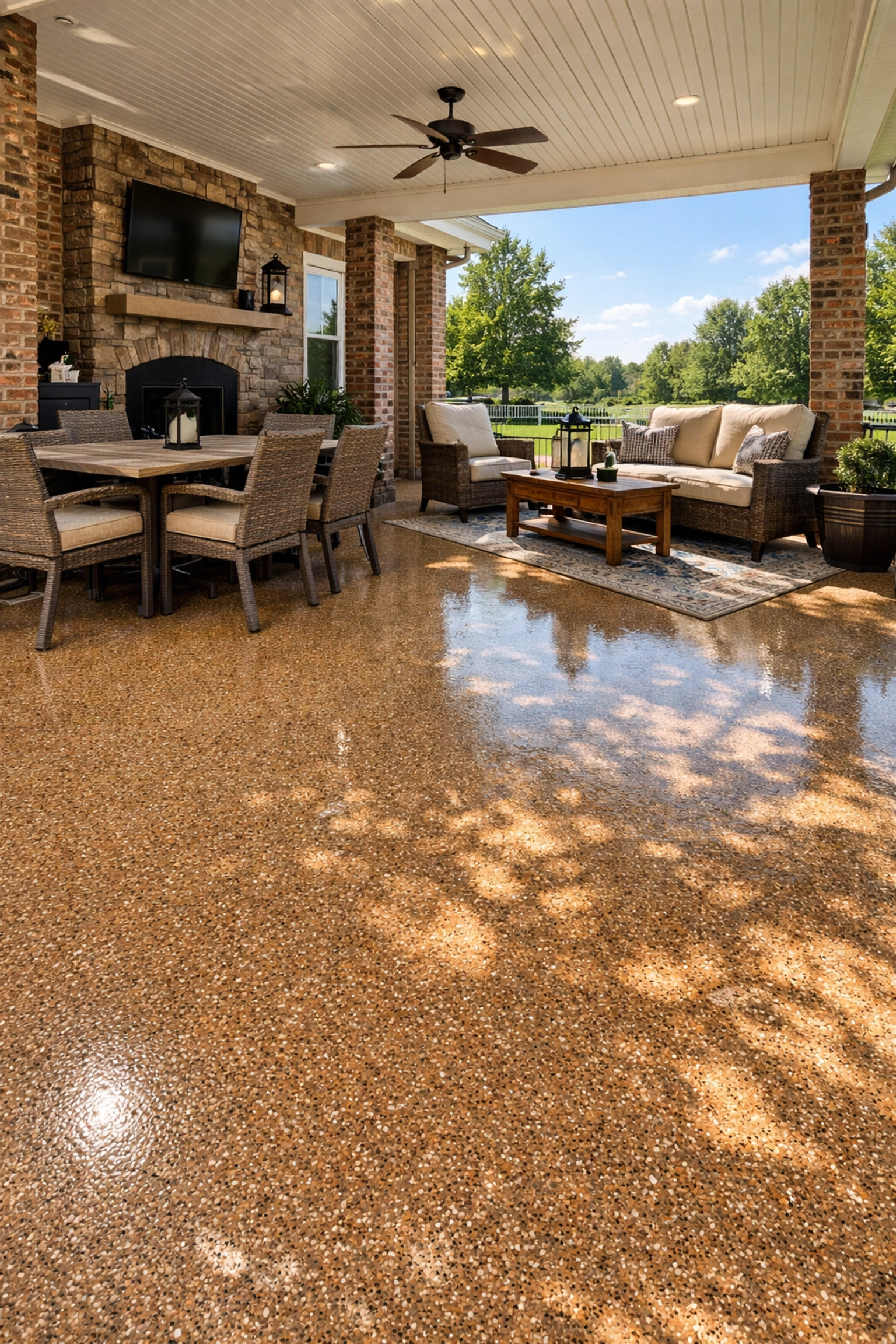
UV Stability Matters: Why Your Polyaspartic Floor Coating Brandon MS Won’t Yellow in the Sun
- Mar 7
- 6 min read
If you live in Brandon, MS, you already know the sun doesn’t play around. Even if your “outdoor” space is technically a garage, the sunlight that pours in through an open door (or side windows) can be enough to change how a floor coating looks over time.
That’s where UV stability comes in.
A lot of homeowners start their search thinking epoxy is epoxy: and anything “clear” will stay clear. Then a year or two later, they notice a warm amber tint creeping into the coating, especially near the door where the sun hits hardest. That’s not dirt. That’s yellowing from UV exposure.
Polyaspartic coatings are built for sun-exposed areas. In this post, we’ll break down why polyaspartic floor coatings resist yellowing, why standard epoxies often don’t, and how to pick a system that stays clean-looking for the long haul in Brandon’s bright, hot conditions.
What “UV stability” actually means for your floor
UV stability is simply a coating’s ability to hold its color and clarity when exposed to ultraviolet light: whether that’s direct sunlight on a patio or indirect sunlight in a garage.
When a coating is not UV stable, you’ll typically see:
Yellowing/ambering (especially noticeable on light gray, white, or clear topcoats)
Loss of gloss (it starts looking dull or “tired”)
Chalking (a fine, powdery film on the surface)
Fading of colored pigments over time
These changes aren’t just cosmetic. UV-driven degradation can also make the top layer more vulnerable to wear.
In Brandon, even “part-time sun” adds up: think weekend garage hangouts with the door up, a home gym in the garage, or a breezeway/patio that gets afternoon sun.
Why epoxy often yellows in sun-exposed areas
Epoxy is popular for a reason: it bonds well to concrete, looks great when it’s fresh, and holds up to daily garage use. But standard epoxies are not inherently UV stable.
Here’s the simplified science: UV light triggers chemical reactions that break down parts of many polymers. In epoxy, that breakdown shows up as discoloration and gloss loss. The effect is strongest where sunlight is most intense: right at the garage threshold, near windows, or along a patio edge.
You may hear that a “UV resistant epoxy” exists. In practice, that usually means one of two things:
It has additives that slow down yellowing (not eliminate it), or
It relies on a separate UV-stable topcoat to protect the epoxy layer underneath
So epoxy can still be part of a great system: but if your top layer isn’t UV stable, you’re rolling the dice in sun-exposed spaces.
Why polyaspartic won’t yellow: the chemistry that matters (without the headache)
Polyaspartic coatings resist yellowing largely because of their aliphatic chemistry.
Many coatings that struggle in sunlight use aromatic chemistry that’s more likely to degrade under UV exposure. Polyaspartics are commonly formulated as aliphatic polyurea systems, made from reactions involving aliphatic polyisocyanates and polyaspartic esters. The key takeaway is simple:
Aliphatic compounds are naturally more resistant to UV light, which helps polyaspartic coatings maintain their color and clarity longer when exposed to sunlight.
That’s why polyaspartic is a go-to choice for:
Garages with doors open daily
Patios and covered porches (even covered areas still get UV)
Driveway-adjacent slabs near reflective light
Sunrooms and spaces with large windows
Any light-colored floor where yellowing would be obvious
If you want a coating that keeps that “just installed” look, UV stability has to be part of the plan: not an afterthought.
The “sun test” in Brandon garages: where yellowing shows up first
Most homeowners don’t notice yellowing across the whole floor. It usually starts in a predictable pattern:
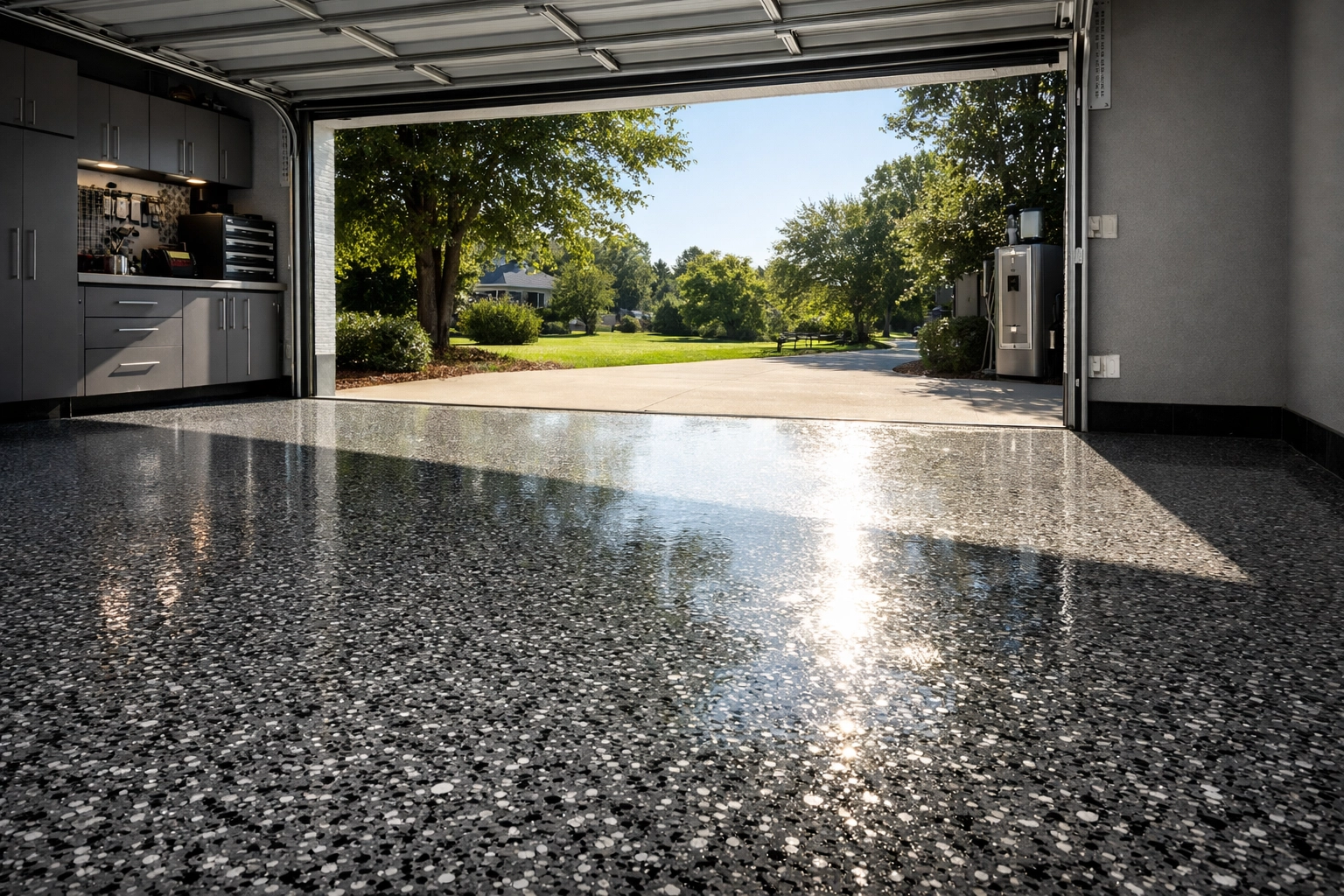
A yellowed band 6–24 inches inside the garage door
A lighter, newer-looking section deeper in the garage
A gradual fade line between the two
That’s because UV exposure is uneven. The front area gets hammered; the back area barely sees sunlight. The contrast makes the discoloration feel more dramatic: even if the coating is still structurally “fine.”
If your garage doubles as a workshop, home gym, or hangout space, appearance matters. Polyaspartic helps you avoid that “two-tone garage” effect.
Polyaspartic vs epoxy for UV stability (quick comparison)
Here’s the practical breakdown for homeowners choosing a system for a Brandon, MS property:
Feature | Standard Epoxy | Polyaspartic |
UV resistance | Fair to poor (often yellows) | Excellent (non-yellowing) |
Best use | Interior, low-UV areas | Sun-exposed garages, patios, bright spaces |
Appearance longevity | Can amber/lose gloss | Holds color and gloss longer |
Cure time | Slower (often multi-day) | Fast (often same-day return) |
Seasonal flexibility | More temperature sensitive | Often works in wider conditions (system dependent) |
Epoxy can still be a strong base layer in some systems, but if UV stability is a priority, the topcoat needs to be UV stable: and polyaspartic is one of the most reliable options.
What about patios, porches, and outdoor concrete in Brandon?
Outdoor coatings have a harder life than garage floors because they deal with:
Full UV exposure
Temperature swings (hot surface temps in summer)
Moisture, rain, and humidity
Wind-blown grit (basically sandpaper)
A UV-stable coating helps with appearance, but it also protects the concrete itself. Sun and heat can contribute to surface drying and long-term stress on the slab. A good coating system acts like a shield: reducing direct exposure and helping the surface stay easier to clean.
If your patio gets sun half the day, a polyaspartic topcoat is a smart way to keep the finish from fading or shifting color.
“Non-yellowing” doesn’t mean “indestructible”: what still matters
UV stability is huge, but it’s only one part of a coating system that performs well year after year. A polyaspartic floor will only look as good as the prep work and the full system design.
Key factors that still matter:
Concrete prep (this is the make-or-break step)
If the concrete isn’t mechanically prepped correctly, coatings can peel: no matter how UV stable they are. Proper prep typically means grinding to open the pores and create a profile the coating can bond to (not just acid etching and hoping for the best).
Moisture vapor
Mississippi humidity is real. If moisture is moving up through the slab and the system isn’t designed for it, you can get bubbling or delamination. The right primer and moisture mitigation approach matters.
Thickness and wear layer
Garages see hot tires, turning, and weight. Patios see grit. A quality system needs a durable wear layer and a topcoat designed to take abuse.
Slip resistance (especially outdoors)
A glossy coating looks great: until it’s wet. If you’re coating a patio, pool-adjacent slab, or even a garage that gets rain blown in, talk about traction additives. (We cover this topic in more depth here: https://www.madisoncoatingscompany.net/post/slip-resistance-matters-why-your-brandon-ms-floor-coating-needs-more-than-just-shine)
Why UV stability is a big deal for lighter colors and decorative flake floors
Yellowing is most noticeable when:
The coating is clear or “high-gloss”
The floor color is light gray, white, tan, or beige
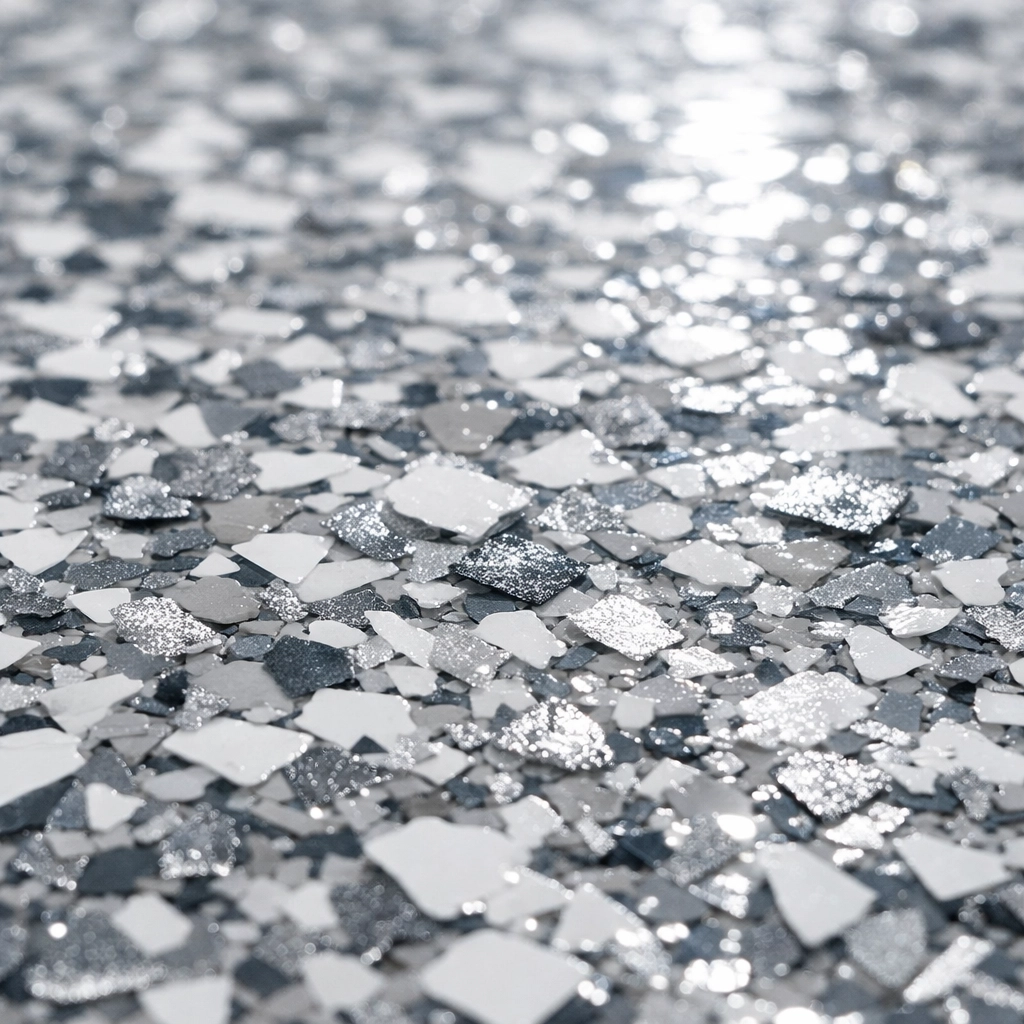
You have a decorative flake blend with whites and light tones
If you’re investing in a bright, clean look, the last thing you want is an amber tint that makes the floor look aged.
Polyaspartic topcoats are a great match for:
Full flake garage floors
Modern light gray designs
Showroom-style high-gloss finishes
Clean, “new build” aesthetics common in newer Brandon neighborhoods
Fast cure is nice, but the real win is keeping the “new floor” look
Polyaspartic coatings are known for quick cure times (often hours, not days). That’s a practical benefit: especially if you need your garage back quickly.
But for sun-exposed areas, the bigger long-term payoff is this:
The coating stays clearer
The gloss holds longer
The color stays true
The floor keeps looking “finished,” not yellowed or dull
For homeowners, that means fewer regrets and a floor that still looks sharp years down the road: whether the garage door is open daily or the patio gets full afternoon sun.
Common questions Brandon homeowners ask about yellowing and UV exposure
“Will my floor never change color?”
No coating is immune to all aging. But a quality polyaspartic topcoat is highly UV stable, which dramatically reduces yellowing compared to standard epoxy in sun-exposed areas. If your goal is “won’t amber at the garage door,” polyaspartic is the right direction.
“Can I just put a clear coat over epoxy to stop yellowing?”
Only if that clear coat is UV stable and installed correctly. Many yellowing complaints come from systems where the topcoat wasn’t truly UV resistant or wasn’t applied at the correct thickness.
“What if my garage only gets a little sun?”
“Some sun” is usually enough to create visible contrast over time, especially on light colors. If the garage door is open regularly, it’s safer to choose UV stability now than to wish you had later.
“Is polyaspartic slippery?”
It can be, depending on finish and additives. You can absolutely build in traction: especially for patios and entry areas: without turning it into a rough, hard-to-clean surface.
Choosing the right UV-stable floor coating in Brandon, MS
If you’re deciding between epoxy and polyaspartic, start with one question:
How much sunlight will hit this floor over the next few years?
If it’s a garage that stays closed and has minimal windows, epoxy can be fine (especially with the right topcoat).
If it’s a garage that lives open, a patio, a porch, or any bright space, polyaspartic UV stability is the smarter play.
Want to see what different colors and flake blends look like before you commit? Check out our visualizer here: https://www.madisoncoatingscompany.net/visualizer
And if you’d like to talk through your space in Brandon: garage, patio, shop, or combo: we’re here. Learn more about what we install on our services page: https://www.madisoncoatingscompany.net/services