
Epoxy Floor Coating Pricing for Moisture-Prone Areas
Table of Contents
What Drives Epoxy Floor Coating Pricing in Moisture-Prone Areas
Material Costs: Standard Epoxy vs. Moisture-Tolerant Systems
Labor Costs: Surface Prep, Testing, and Application Time
Moisture Vapor Barrier Epoxy Cost: What Adds to the Bottom Line
Polyaspartic vs. Epoxy for Damp Concrete: Which Costs Less Long-Term?
Upfront Material and Labor Cost
Moisture Tolerance and Failure Risk
Service Life and Repair Cycles
Which One to Specify
Concrete Moisture Testing Services in Madison, MS: Why Testing Comes First
Hydrostatic Pressure Testing and Regional Moisture Challenges
DIY vs. Professional Installation: Where the Real Costs Hide
The Moisture Test Is the Line Item DIY Kits Skip
What Professional Installation Actually Bundles
The Warranty Gap Nobody Talks About
When DIY Makes Sense
How Mississippi's Climate Affects Curing Time and Project Pricing
Warranty Implications for Moisture-Prone Areas: What to Ask Before You Buy
Frequently Asked Questions
Last Updated: September 29, 2026
What Drives Epoxy Floor Coating Pricing in Moisture-Prone Areas
Epoxy floor coating pricing in moisture-prone areas is shaped by three cost centers: materials, labor, and moisture mitigation. In Madison, Mississippi, where the water table runs high and summer humidity rarely drops below 70%, that third line item can rival the first two combined. This guide from Madison Coatings Company breaks down each cost driver so you can budget realistically instead of guessing.
Material Costs: Standard Epoxy vs. Moisture-Tolerant Systems
Standard epoxy resin costs less per kit than moisture-tolerant formulas, but that gap is the wrong place to save money. Water-based epoxy sits at the budget end; solid epoxy and polyaspartic systems cost more because they handle damp substrates and UV exposure without failing. A moisture vapor barrier epoxy cost typically runs above a standard system because it adds a dedicated barrier layer or a specialized primer coat.
Labor Costs: Surface Prep, Testing, and Application Time
Labor usually outpaces materials, and surface preparation is the reason. Diamond grinding and shot blasting remove old coatings, contaminants, and laitance so the new epoxy bonds to sound concrete. Skipping that step is the most common mistake we see from failed DIY jobs.
Cost Factor | What It Covers | Why It Matters in Damp Slabs |
Materials | Epoxy resin, primer, topcoat, flake | Moisture-tolerant formulas cost more |
Surface prep | Diamond grinding, shot blasting, patching | Poor prep causes peeling and flaking |
Moisture testing | ASTM calcium chloride or RH testing | Confirms whether a vapor barrier is needed |
Labor | Application, cure monitoring, cleanup | Humidity extends cure time and labor hours |
Mitigation | Vapor barrier primer, moisture-tolerant base | Added only when test results require it |
Moisture Vapor Barrier Epoxy Cost: What Adds to the Bottom Line
A moisture vapor barrier epoxy cost reflects one extra protective layer and the testing that justifies it. The barrier blocks moisture vapor emission from migrating through the slab and pushing the coating off from below. Without it, hydrostatic pressure can lift a floor within months.
Watch Out Applying standard epoxy over a slab with high moisture vapor emission is the fastest route to blistering and delamination. The coating fails from underneath, and no warranty covers a floor installed without a passing moisture test.
Polyaspartic vs. Epoxy for Damp Concrete: Which Costs Less Long-Term?
Polyaspartic vs. epoxy for damp concrete comes down to three cost variables: upfront material price, cure-window labor, and how many times you pay for the floor over its service life. Most national guides stop at the first one. In a moisture-prone slab, the second and third variables usually decide the winner.
Columbus Epoxy Flooring
Upfront Material and Labor Cost
Polyaspartic resins cost more per mixed gallon than standard epoxy, and a polyaspartic system is typically applied as a base coat plus a clear topcoat rather than the multi-coat epoxy build. That narrower coat count offsets part of the material premium. The bigger swing is labor: polyaspartic returns to service in hours instead of overnight, so a two-car garage in Madison can be coated and back in use in a single day, while a standard epoxy system usually needs a second day for recoat and cure.
Moisture Tolerance and Failure Risk
Standard epoxy is not formulated to tolerate active moisture vapor emission. When a slab is emitting vapor above the coating's tolerance, epoxy blisters from below regardless of how well the surface was prepped. Polyaspartic handles damp substrates better and can be applied over a properly profiled slab at higher moisture readings, but it is not a substitute for a vapor barrier when MVER results are high.
Service Life and Repair Cycles
Epoxy remains the workhorse for interior slabs where sunlight never reaches. It resists abrasion well and holds up under forklift and vehicle traffic. Its weakness is UV: direct sun yellows an epoxy topcoat and breaks down the finish over time. Polyaspartic resists UV yellowing, so it holds color on pool decks, patios, and sun-exposed garage aprons.
Which One to Specify
Situation | Better Choice | Why |
Interior slab, low MVER, no sun | Standard epoxy | Lower material cost, proven durability |
Damp slab with passing MVER after mitigation | Epoxy over vapor barrier primer | Barrier handles moisture, epoxy handles wear |
Sun-exposed slab, damp climate | Polyaspartic | UV stable, faster cure in humidity |
High MVER, hydrostatic pressure | Barrier system first, then either topcoat | No coating survives unmitigated vapor |
Key Takeaway The cheaper coating is not the one with the lower per-square-foot quote. It is the one that survives the moisture reading your slab actually produced.
Concrete Moisture Testing Services in Madison, MS: Why Testing Comes First
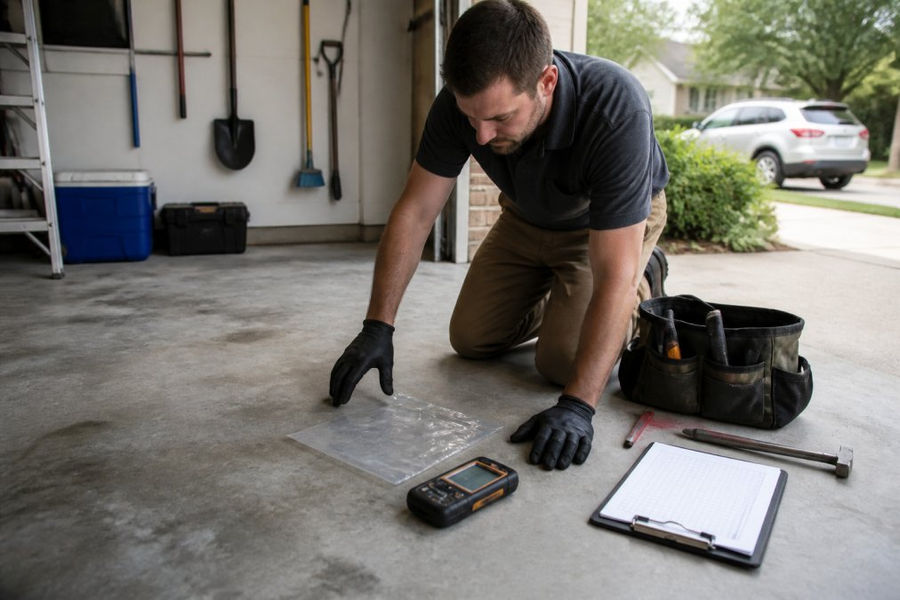
Concrete moisture testing services in Madison, MS exist because local slabs sit close to a high water table and absorb seasonal humidity. Testing measures moisture vapor emission and relative humidity inside the slab before any coating goes down. It's the single step that determines whether your project needs a vapor barrier.
Hydrostatic Pressure Testing and Regional Moisture Challenges
Hydrostatic pressure testing measures water pushing up through a slab from saturated ground beneath. Around Madison County, that pressure builds after heavy spring rains and stays elevated through summer. A slab that reads dry in February can read wet in June.
DIY vs. Professional Installation: Where the Real Costs Hide
DIY kits look cheaper on the shelf. In a moisture-prone area, the hidden costs show up later and they are not small: rental equipment for diamond grinding, patching compounds for cracks and spalls, moisture test kits, and the value of your own weekends. When a DIY coating fails over a damp slab, you pay twice, once for the kit and again for removal and a professional redo.
The Moisture Test Is the Line Item DIY Kits Skip
Most retail epoxy kits do not include a moisture vapor emission test, and the instructions rarely tell you to run one. That omission is the single biggest cost difference between DIY and professional work in a damp climate. A calcium chloride test or an in-situ relative humidity probe tells you whether the slab is emitting vapor above the coating's tolerance before you open a can.
What Professional Installation Actually Bundles
Professional installation folds testing, prep, materials, and warranty into one number. The U.S. Environmental Protection Agency guidance on indoor air quality during renovations is worth reviewing before any coating project, since proper ventilation and product selection affect both safety and finish quality. A professional quote in a moisture-prone area should also include:
Moisture vapor emission testing (ASTM F1869 calcium chloride or ASTM F2170 in-situ RH)
Diamond grinding or shot blasting to the correct concrete surface profile
Crack and spall repair with a rigid or semi-rigid patching compound
A vapor barrier primer or moisture-tolerant base coat if test results require it
A written workmanship warranty that states what moisture conditions it covers
The Warranty Gap Nobody Talks About
Standard epoxy warranties frequently exclude moisture-related failure. Read the fine print: many manufacturers void coverage when the slab was not tested, when MVER readings exceeded the product's published limit, or when no vapor barrier was installed. That means a DIY floor that blisters from below is often a total loss with no recourse, and even some professional installs lose coverage if the contractor skipped testing.
Before you buy, ask three questions:
Did you test the slab for moisture vapor emission and relative humidity?
Does the quote include a vapor barrier if test results require one?
Does the warranty cover delamination caused by moisture, or exclude it?
Watch Out A workmanship warranty is only as strong as the prep behind it. In a moisture-prone area, a warranty that does not mention moisture testing is a warranty that will not pay for a moisture failure.
When DIY Makes Sense
DIY can pencil out on a small, interior, confirmed-dry slab where you have already run a moisture test and the reading is well under the product's limit. It rarely pencils out on a garage, basement, or commercial slab in a high-water-table area, because the prep and testing that make the coating bond are exactly the steps the kit leaves out.
How Mississippi's Climate Affects Curing Time and Project Pricing
Mississippi's heat and humidity stretch epoxy curing time, and longer cure windows raise labor costs. Epoxy cures through a chemical reaction that slows in high humidity and accelerates in heat, which makes spring and fall the most predictable installation seasons. Summer projects need careful scheduling and sometimes faster-curing polyaspartic instead.
Warranty Implications for Moisture-Prone Areas: What to Ask Before You Buy
Warranty coverage in moisture-prone areas depends on whether the installer tested and mitigated properly. A workmanship warranty is only as strong as the prep behind it. Before you buy, ask three questions:
Did you test the slab for moisture vapor emission and relative humidity?
Does the quote include a vapor barrier if test results require one?
Does the warranty cover delamination caused by moisture, or exclude it?
Frequently Asked Questions
How much does it cost to epoxy 1,000 square feet of flooring in Mississippi?
Pricing for a 1,000-square-foot epoxy floor depends on slab condition, moisture levels, and the coating system chosen. In moisture-prone areas, additional testing and a vapor barrier primer raise the total. Madison Coatings Company provides itemized quotes based on square footage, surface prep needs, and moisture mitigation requirements. Contact them directly for current pricing.
Does high humidity in Madison affect epoxy floor pricing?
Yes. High humidity slows curing and can trap moisture under the coating, causing adhesion failure. Contractors must account for longer cure windows and may use polyaspartic topcoats that cure faster in humid conditions. These adjustments add to labor and material costs. Proper moisture testing and climate-adjusted scheduling are factored into every quote for moisture-prone areas.
What is the price difference between standard epoxy and moisture-vapor barrier systems?
Moisture vapor barrier epoxy costs more than standard epoxy because it requires specialized primers, additional surface prep, and often a longer installation process. The exact difference depends on the severity of moisture and the square footage involved. While the upfront cost is higher, a vapor barrier prevents peeling and extends the floor's service life, reducing long-term repair expenses.
Why is moisture mitigation necessary before applying epoxy in Madison, MS?
Mississippi's high water table and humid climate push moisture vapor through concrete slabs. Without mitigation, epoxy traps that vapor, leading to bubbles, peeling, and premature failure. Moisture testing identifies the vapor emission rate, and a vapor barrier primer blocks it. Skipping this step voids most warranties and leads to costly repairs within a year or two.
Moisture is the variable that separates a floor that lasts from one that peels within a year. Madison Coatings Company handles the testing, surface preparation, and moisture-tolerant systems that Madison-area slabs demand, from polymer flake garage floors to chemical-resistant commercial coatings. Get a quote from Madison Coatings Company and start with a moisture test, not a guess.
Get Started Today